 How-to
Is Pottery a Good Hobby for Stress Relief?
Last Updated: November 1, 2026
Quick Summary
Yes, is pottery a good hobby for stress relief for most people, though the strongest evidence is promising but early. A case study of a university ceramic art course reported a tangible enhancement in mental health, and clay work keeps your hands busy and your attention anchored. It is a supportive habit, not a treatment.
- Pottery's mental health benefits are real but modest, offering a calm, structured creative outlet many find restorative.
- Pottery can give a restless mind a physical task to focus on, which some people find calming.
- Beginners often find pottery frustrating at first, and that is normal as skills build each session.
- Choose hand-building at a table if the wheel feels physically demanding on wrists or back.
- A weekly clay routine works best when it is small, repeatable, and scheduled.
Table of Contents
- Why Pottery Stress Relief Works: What the Evidence Actually Says
- The Benefits of Pottery for Mental Health Beyond the Hype
- How Pottery Helps With Anxiety: Racing Minds and Steady Hands
- Pottery as a Mindfulness Practice: Being Present at the Wheel
- Realistic Expectations: What Beginners Find Frustrating
- Beginner Pottery Classes: What to Look For and What to Ask
- Building a Weekly Clay Routine for Stress Relief
- Book Your First Pottery Session at Uncle Dave's Art Studio
- Frequently Asked Questions
Why Pottery Stress Relief Works: What the Evidence Actually Says
Is pottery a good hobby for stress relief? Yes, for most people, with one honest caveat: the strongest evidence is promising but early. At Uncle Dave's Art Studio, we want to be straight about what science can and can't back up.
A case study of a university's ceramic art course reported that creating ceramic art produced a tangible enhancement in mental health (ceramic art course case study(https://pmc.ncbi.nlm.nih.gov/articles/PMC10954310/)). That's a real finding from a real program. It's also one small study, not a guarantee.
What Research Can and Cannot Tell You
Research can tell you that people in structured clay programs tend to report feeling better. It cannot tell you pottery will cure anxiety, replace therapy, or work the same way for everyone.
Here's what most guides get wrong: they treat a small study as proof. It isn't. Think of the evidence as encouraging, not conclusive.
What we can say with confidence:
- Clay work keeps your hands busy and your attention anchored
- The process is slow, physical, and screen-free
- Many beginners describe a calm, focused state at the wheel
- Results vary by person, and that's normal
The Benefits of Pottery for Mental Health Beyond the Hype
Pottery's mental health benefits are real but modest. The hobby offers a calm, structured creative outlet that many people find genuinely restorative. It is not a treatment.
The EXTERNAL_LINK: broader case for creative art classes | page:5 covers how different creative outlets support wellbeing. Pottery has its own flavor: it's tactile, forgiving of imperfection, and impossible to rush.
What the benefits actually look like in practice:
- A racing mind gets something concrete to hold onto
- Small wins, like a centered lump of clay, build momentum
- You make something with your hands instead of consuming content
- You join a room of people doing the same quiet work
That last one matters. Many people find the social side of a studio as calming as the clay itself.
How Pottery Helps With Anxiety: Racing Minds and Steady Hands
Pottery can give a restless mind a physical task to focus on, which some people find calming.
Anxiety often shows up as a mind that won't stop. Clay work interrupts that loop. You can't shape a bowl and mentally replay tomorrow's meeting at the same time. The wheel demands attention.
A few ways this plays out:
- Focus: The clay pulls your eyes and hands into one spot
- Breathing: Slow, steady wheel work tends to slow your breathing too
- Control: You learn to guide clay gently instead of forcing it
Watch out: pottery won't fix clinical anxiety on its own. If anxiety is affecting your daily life, talk to a doctor or licensed therapist. Use pottery as a supportive habit, not a substitute for care.
Pottery as a Mindfulness Practice: Being Present at the Wheel
Pottery is a mindfulness practice in disguise. The wheel naturally pulls you into the present moment, because the clay only responds to what you do right now. For deeper guidance, explore these beginner pottery wheel throwing techniques.
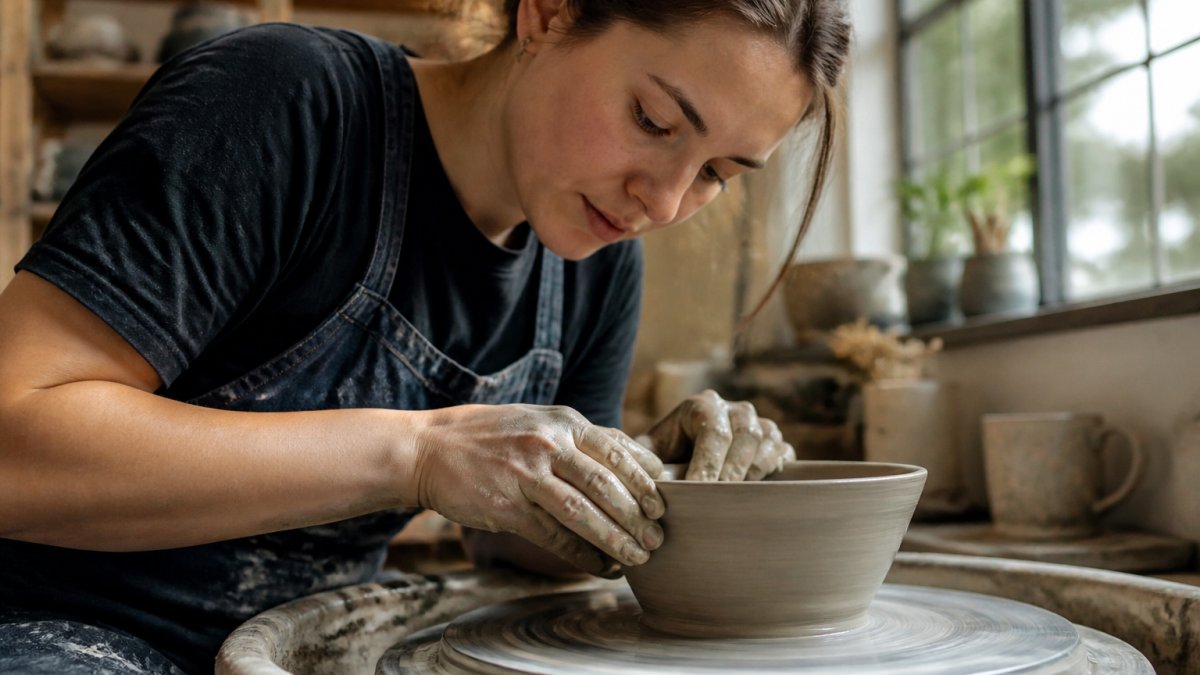
A simple way to treat pottery as mindfulness:
- Set your phone away before you sit down
- Take three slow breaths before you touch the clay
- Notice the cool, damp feel of the clay in your hands
- When your mind wanders, return to the spinning wheel
- Let the piece be imperfect
That last step is the hard one. And it's where the real practice lives.
Realistic Expectations: What Beginners Find Frustrating
Beginners often find pottery frustrating at first, and that's normal. The first few sessions are humbling. Clay collapses, centers refuse to center, and bowls turn into lumps. What most guides skip is why this happens and what to do about it.
A common mistake is expecting a finished masterpiece in week one. Most people don't get there. What they do get is a calmer hour and a little more skill each time.
Common early frustrations:
- Clay that won't stay centered on the wheel. Centering requires steady, even pressure from both hands while the wheel spins. If you're struggling with it, this step-by-step guide to centering clay walks you through the process. Beginners tend to push too hard on one side, which knocks the clay off-axis. The fix is slower wheel speed and lighter pressure, not more force.
- Walls that get too thin and flop. Pulling walls upward thins them quickly. Most beginners pull one or two times too many. Stop earlier than feels right.
- Pieces that crack during drying. Clay shrinks as it dries, and uneven thickness creates stress that shows up as cracks. Keep walls and bases consistent in thickness and let pieces dry slowly under plastic.
- Feeling like everyone else is better than you. In a mixed-level class, you are comparing your first hour to someone else's fiftieth. That comparison is not information.
None of that means you're bad at it. It means you're learning.
When pottery may not feel relaxing. Honesty matters here. Pottery is not a universal stress reliever. Some people find the mess, the noise of a studio, or the time pressure of a fixed class length more stimulating than soothing. Wheel work requires sustained grip and posture that can aggravate wrist, shoulder, or back issues. If you have sensory sensitivities, wet clay on the hands can be unpleasant rather than calming. Physical demands that turn a creative session into a source of tension often necessitate a shift toward structured movement like martial arts for stress to regain a sense of equilibrium.
Ways to adapt rather than quit:
- Choose hand-building at a table if the wheel feels physically demanding.
- Try pottery painting if wet clay texture is the problem.
- Pick a studio with small classes if crowds raise your stress rather than lower it.
- Take a shorter session if a two-hour block feels like too much.
- Practice at home in short bursts if travel to a studio is a barrier.
A useful rule: judge pottery by how you feel during and just after a session, not by what you produced. If the process itself is not calming after two or three honest tries, it is fine to try a different creative outlet. Pottery is a supportive habit, not a test of character.
Beginner Pottery Classes: What to Look For and What to Ask
Good beginner pottery classes share a few traits that are worth checking for at any studio. But the format you choose matters as much as the studio's reputation, and the three main entry points feel very different on day one.
Ask these questions before you sign up:
- How many students per instructor?
- How much time is actually spent with your hands in clay?
- Are clay, glazes, and firing included in the price, or billed separately?
- Is the environment welcoming to total beginners?
- Do you offer evening or weekday sessions?
- Can you accommodate kids or adults with sensory needs?
On cost: pricing depends on the format and what is included, so ask for the all-in number before you commit. For current prices, visit the Uncle Dave's Art Studio website or contact the studio for a quote.
At Uncle Dave's Art Studio, we welcome artists of all ages and skill levels into an inclusive, encouraging space. That's the whole point.
| What to Check | Why It Matters | What to Ask |
|---|---|---|
| Class size | More hands-on help | Students per instructor? |
| Wheel time | Real practice, not watching | Minutes at the wheel? |
| Materials | No surprise costs | All-in price with clay and firing? |
| Format | Matches your comfort level | Hand-building, wheel, or painting? |
| Schedule | Fits your week | Evening sessions available? |
| Inclusivity | Comfort for all learners | Support for sensory needs? |
Building a Weekly Clay Routine for Stress Relief
A weekly clay routine works best when it's small, repeatable, and scheduled. One steady session beats an occasional marathon.
A simple weekly rhythm:
- One studio session for guided practice
- One short home session for hand-building or sketching ideas
- A few quiet minutes to look at what you made, without judging it
The goal isn't output. It's the calm, repeatable ritual of showing up for something slow and tactile. If you want to practice at home without a wheel, here's how to start pottery without buying a wheel.
Book Your First Pottery Session at Uncle Dave's Art Studio
The hardest part of pottery is starting. The clay does the rest once your hands are in it.
If you're ready to try it, you can get started with a class at Uncle Dave's Art Studio.
We offer classes across pottery, stained glass, painting, drawing, and ceramics, for all ages and skill levels. Come make something with your hands. Get started with Uncle Dave's Art Studio and find your weekly calm at the wheel.
Frequently Asked Questions
Can pottery help reduce stress and anxiety?
Pottery can support stress relief by giving your hands and attention a single, absorbing task. The tactile experience of working with clay, the focus required at the wheel, and the screen-free time all contribute. Pottery is a complement to, not a replacement for, professional mental health care.
How often should you do pottery for stress relief?
A weekly session is a practical starting point for most beginners. One class or studio visit per week gives you a repeatable relaxing ritual without overwhelming your schedule, and many people find the anticipation of that session helps during stressful weeks. If you keep a small amount of clay at home, short 45-minute hand-building sessions between classes can reinforce the habit.
Can pottery be frustrating if you are a beginner?
Yes, and knowing that upfront helps. Wheel throwing in particular takes time: clay collapses, centers unevenly, and your first bowls may be lopsided. Hand-building tends to feel more forgiving early on. The key is treating early pieces as practice rather than finished work. Beginner pottery classes exist precisely to walk you through those frustrations with an instructor nearby.
Is pottery better for stress relief than painting?
Neither is universally better; they suit different people. Pottery offers a tactile, physical engagement with clay that many find grounding, while painting may appeal if you prefer color and two-dimensional work. Some people use both. If you are unsure, try a single introductory class in each medium and notice which one holds your attention more easily.