 How-to
How to Choose a Pottery Team Building Event That Works
Last Updated: November 24, 2026
Quick Summary
Choosing a pottery team building event comes down to four decisions: format, delivery method, your group's skill mix, and session length. Settling these before booking helps the team get the most from the day. Match the pottery team building format to your goal rather than to experience level alone.
- Choose wheel throwing, handbuilding, or painting based on your team goal and skill level.
- Handbuilding suits mixed-experience groups because it needs little to no prior skill.
- Painting is the shortest and lowest-mess option, suited to large groups and short time slots.
- Request a written quote that itemizes materials, firing, shipping, and travel fees.
- Ask whether the quoted session length includes setup and cleanup time.
Table of Contents
- How Do I Choose a Pottery Team Building Event?
- Why Pottery Works as a Team Building Activity
- Choosing a Format: Wheel Throwing, Handbuilding or Painting
- Corporate Pottery Workshop Options: In-Person, Virtual or On-Site
- Pottery Workshop Ideas for Teams Across Skill Levels
- Pottery Class Duration for Groups and Budget Factors
- Your Pottery Event Planning Checklist and Next Step
- Frequently Asked Questions
How Do I Choose a Pottery Team Building Event?
Choosing a pottery team building event comes down to four decisions: the format, the delivery method, the skill mix of your group, and the length of the session. Teams that settle these four questions before booking tend to get the most from the day.
A useful starting point is group size.
Keep these questions in mind as you read through the sections below:
- How many people will attend, and how many have any experience with clay?
- Do you want a hands-on wheel session, a handbuilding project, or a painting activity?
- Will the event happen on-site, at a studio, or online?
- How long can your team step away from regular work?
- What is the budget, and what does it need to cover?
Why Pottery Works as a Team Building Activity
Pottery works because it asks people to slow down and focus on one shared task. Hands-on craft gives participants something concrete to talk about, which lowers the pressure of small talk with colleagues they do not know well. Working side by side on a project also gives teams a low-stakes chance to practice communication and patience. That shared focus can also shape a longer team experience, with planning an immersive craft workshop giving colleagues more time to build trust through making together.
Pottery also has a built-in learning curve. Nobody centers clay perfectly on the first attempt, so beginners and experienced staff start on a more even footing than they would in a sales exercise or a presentation. That shared experience of struggling and improving together is often what makes the activity memorable.
Some providers describe their workshops in terms of company values. If your team wants a finished item that reflects its culture, ask whether the studio can tailor the project.
Choosing a Format: Wheel Throwing, Handbuilding or Painting
Most pottery team events fall into one of three formats, and the right choice depends less on which sounds most fun and more on five practical variables: skill level, session time, mess tolerance, physical accessibility, and the outcome your team wants. If painting looks like the better fit, a practical guide to running a group painting activity walks through how it works for work teams. Use the comparison below to review them side by side before you request quotes.
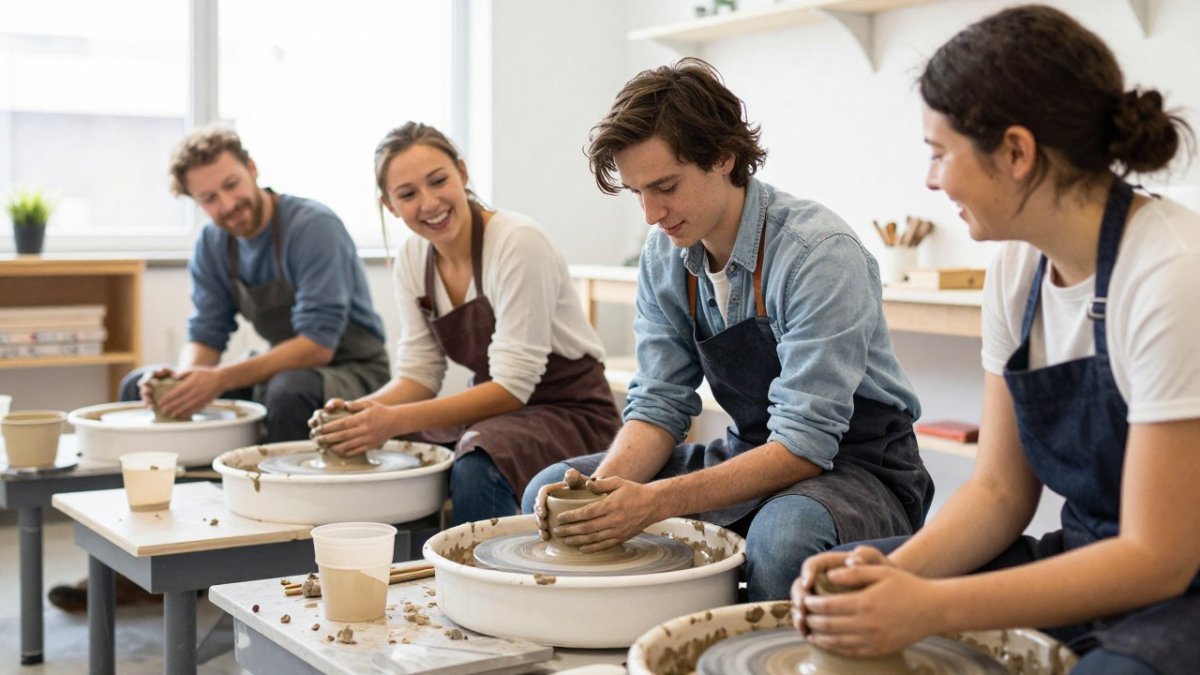
Use this comparison to match a format to your group:
| Format | Best for | Skill needed | Typical session time | Mess level | Accessibility | Desired outcome |
|---|---|---|---|---|---|---|
| Wheel throwing | Groups that want a challenge | Some practice helpful | Longer, technique plus drying | High (water, splash) | Lowest, seated, sustained pressure | Accomplishment, focus |
| Handbuilding | Mixed-experience groups | Little to none | Moderate | Moderate (crumbs, tools) | High, seated or standing | Collaboration, conversation |
| Painting | Large groups or short time slots | None | Shortest | Low | High, seated, low dexterity demand | Social, low-pressure |
A common pattern is to match the format to the team goal rather than the team's experience level. If the goal is breaking down silos between departments, handbuilding's shared table work and varied results tend to generate more cross-conversation than wheel throwing, where participants are heads-down at individual wheels. If the goal is a memorable challenge or a reward for a high-performing team, wheel throwing delivers a sharper shared struggle. If the goal is inclusion, a large group, a short window, or a mix of physical abilities, painting or handbuilding keeps everyone participating rather than spectating.
If your team is split between people who want a challenge and people who are nervous, ask the studio whether it can offer a mixed format that suits both.
Corporate Pottery Workshop Options: In-Person, Virtual or On-Site
A corporate pottery workshop can happen in three ways: at a studio, at your office or venue, or online. Each has trade-offs.
Ask the studio which delivery methods it supports for your event, and whether it can handle your group size on that date.
Pottery Workshop Ideas for Teams Across Skill Levels
Most teams have a mix of experience levels, and a good event plan accounts for that. Beginner-friendly instruction is the most important feature to check. Ask whether the instructor guides every participant through each step, and whether there is help for anyone who falls behind.
For groups with no prior experience, consider these approaches:
- Choose handbuilding or painting so nobody starts at a disadvantage.
- Ask for a short demonstration before hands-on time begins.
- Pair experienced participants with newcomers only if they want to help. Do not assume.
For more experienced groups, wheel throwing gives people room to improve over the session. Some teams also enjoy a friendly comparison of finished pieces at the end.
Uncle Dave's Art Studio welcomes artists of all ages and skill levels, and we can talk through which option fits your group.
Pottery Class Duration for Groups and Budget Factors
Session length and total cost are the two questions planners ask first, and they are linked: longer sessions and more complex formats cost more because they consume more instructor time, materials, and kiln space. The sections below give you a way to estimate both before you request quotes.
How long does a pottery team event take?
Most group sessions also include a demonstration, hands-on work, and cleanup, so ask each provider whether their quoted duration covers setup and cleanup or only the activity itself.
A common pattern is to add buffer time on both ends of the quoted session: arrival and settling, and cleanup and departure. If your team is traveling to a studio, factor in transit; if the event is on-site, factor in setup and teardown in your own space.
What drives the cost of a pottery team building event?
Pricing depends on group size, date, format, delivery method, and what is included. The reliable way to compare providers is to request a written quote that itemizes each of the following line items, then compare totals on equal terms:
- Per-person or flat group rate, confirm which pricing model applies and whether there is a minimum group size or minimum spend.
- Instruction, how many instructors are present, and whether the ratio changes for larger groups.
- Materials, clay, glaze, paint, and tools, and whether they are included or billed separately.
- Firing, whether kiln firing is included, and whether it is priced per piece or per participant.
- Shipping or pickup, finished pieces usually need to be fired and may be ready weeks later; confirm whether delivery is included or an add-on.
- Travel fees, on-site events often carry a travel or setup fee based on distance and group size.
- Add-ons, personalization, branded pieces, refreshments, or extended session time.
Ask the studio to state explicitly whether firing, glazing, and delivery of finished pieces are included, and get that in writing before you compare totals.
How to build a budget estimate
Start with the per-person rate multiplied by your confirmed headcount, then add the line items above that are not included. Add a contingency for participants who make more than one piece, for firing overages, and for travel if the event is on-site. Request quotes from at least two providers using the same headcount, format, and date so the comparison is apples to apples. If your budget is fixed, tell each provider the number up front and ask what format and group size fit within it, many studios can adjust the project or session length to hit a target.
For current pricing at Uncle Dave's Art Studio, visit our website or contact us for a quote tailored to your group.
Your Pottery Event Planning Checklist and Next Step
Before you book, use this checklist to confirm the details that most often cause problems:
- Confirm the final headcount and any participants with mobility or sensory needs.
- Choose a format: wheel throwing, handbuilding, or painting.
- Decide on delivery: in-person at a studio, on-site, or virtual.
- Ask what instruction is included and how many instructors will be present.
- Request a written quote that lists materials, firing, and any travel fees.
- Confirm the session length and how cleanup and drying time are handled.
- Ask about personalization options tied to your team's values or branding.
- Check cancellation and rescheduling terms.
Once you have answers to these questions, you can compare providers on equal terms. Visit our website to see current offerings, or get in touch for a quote.
Frequently Asked Questions
Is pottery a good team building activity for beginners?
Tell the studio up front that your group includes beginners so the instructor can plan the pace and the project.
How many people can take part in a pottery team building event?
Ask the studio directly whether it can handle your headcount, such as 20 to 30 people, and how it staffs the session. Sizing the group early helps you compare providers on equal terms, and pricing should be confirmed with the studio based on quantity, dates and delivery.
How long should a pottery team building workshop last?
Ask the studio how long a session runs for your group size and whether finished pieces are fired and returned later. Build in time for cleanup and transitions so the schedule holds.
What should I ask a studio before booking a pottery team building event?
Ask how many people the studio has hosted for corporate or church groups, whether instructors have teaching experience, and what formats are available. Confirm what materials and cleanup are included, and ask how the studio supports participants who have sensory or accessibility needs. For current prices and a quote, contact Uncle Dave's Art Studio directly.