 How-to
Art Classes for Adults with Sensory Needs: 2026 Guide
Table of Contents
- Why Art Classes for Adults with Sensory Needs Are Worth Trying
- What to Look for in Sensory-Friendly Art Classes for Adults
- Inclusive Art Studio Accommodations That Actually Help
- Sensory-Friendly Art Activities for Adults: Which Mediums Fit Best
- Art Classes for Adults with Disabilities: Accessibility and Support
- What to Expect Before, During, and After Your First Class
- How to Choose the Right Class for Your Sensory Preferences
- Frequently Asked Questions
Last Updated: October 5, 2026
Why Art Classes for Adults with Sensory Needs Are Worth Trying
Art classes for adults with sensory needs offer a structured, low-pressure way to make things with your hands within the stimulation level your nervous system can handle.
A brush stroke, a lump of clay, a sheet of glass: each asks for attention in a way that crowds out the noise in your head. The American Art Therapy Association's overview of art therapy describes how guided creative work supports emotional regulation and self-expression, and that principle holds whether you are in a formal therapy session or a weekend pottery class.
How Creative Expression Supports Relaxation and Stress Relief
Creative expression supports relaxation because it occupies the senses deliberately rather than overwhelming them. When your hands shape clay or guide a brush, attention narrows to texture, pressure, and color, and the mental chatter quiets.
Many adults describe the studio hour as decompression time, not performance time: no score, no deadline, no audience, a real difference for someone managing sensory overload all week.
What to Look for in Sensory-Friendly Art Classes for Adults
The best sensory-friendly art classes for adults share three traits: predictable structure, a calm space, and an instructor who adapts without making it a big deal.
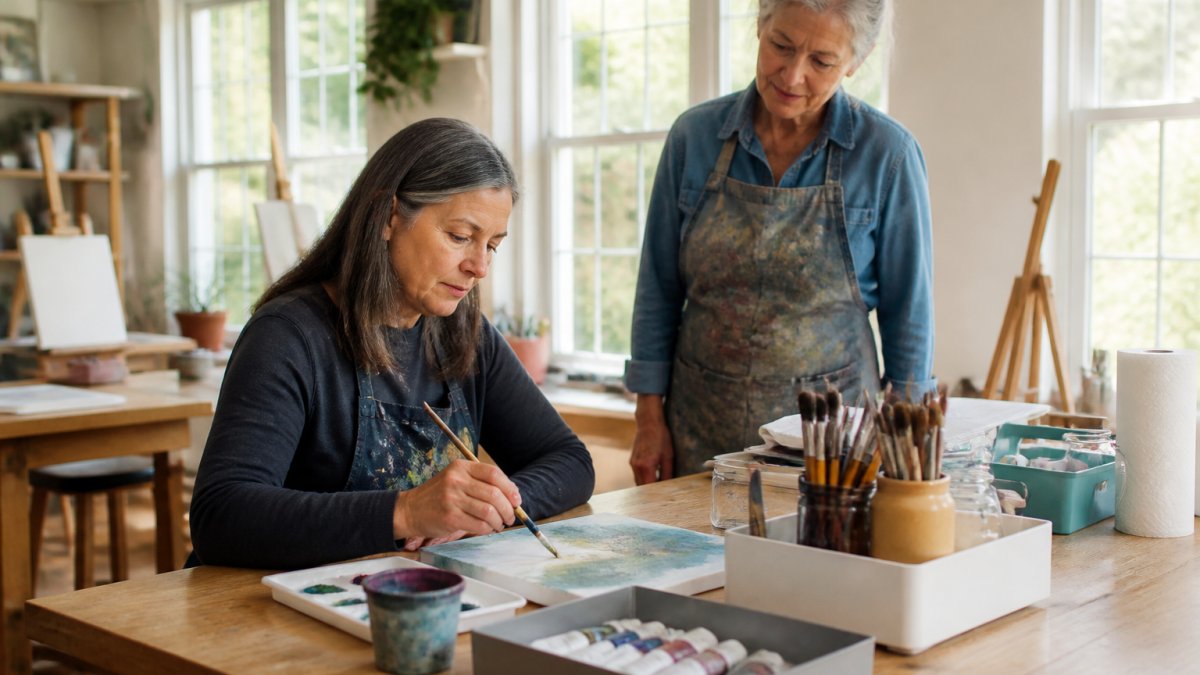
Look past the website photos and ask about the room itself. A welcoming space usually has:
- A quiet corner or separate room you can step into if you need a break
- Adjustable lighting that can be dimmed or softened on request
- Clear, uncluttered workstations so visual noise stays low
Questions to Ask an Art Instructor Before You Enroll
Ask direct questions before you pay. A confident teaching artist will welcome them.
- How do you adjust instruction for students who need extra processing time?
- Can I bring noise-reducing headphones or wear sunglasses during class?
- What happens if I need to leave the room mid-session?
An instructor who hesitates is telling you something useful.
Inclusive Art Studio Accommodations That Actually Help
Real accommodations are practical, not symbolic. A studio that genuinely supports sensory needs adjusts the environment and materials, not just posts an inclusive statement on its homepage. The gap most studios leave is the how: what to ask for and what it looks like in practice.
Lighting, Sound, and Seating Adjustments
Fluorescent overhead lighting is a common culprit.
Sound matters just as much. Background music, echoing rooms, and stools scraping tile all add up. Concrete asks that work:
- Request a music-free session or a specific genre at low volume, rather than "quieter music."
- Ask about hard vs. soft flooring. Concrete and tile bounce sound; carpet, rugs, and cork pads on stool legs cut it noticeably.
- Bring noise-reducing headphones or earplugs and confirm in advance that wearing them is fine. Most instructors treat this as a non-issue; a few ask that you still hear safety instructions, which is reasonable in a glass or kiln studio.
Seating should let you choose a spot near the door, window, or facing a wall. Ask whether you can pick your own seat on day one and keep it for the session, for many adults, a predictable seat is worth more than any equipment.
Some adults find a heavier apron or weighted lap pad helps them stay grounded; others simply need to know where the exits are. A good studio treats both as reasonable.
Materials, Air Quality, and Tool Adaptations
Sensory reactions to art supplies are often about smell and residue as much as texture. If solvents bother you, ask whether the studio uses water-based paints, acrylics, or water-mixable oils instead of traditional oils and mineral spirits. If pigments or dust bother you, ask about dust extraction at sanding stations and whether dry media like graphite, charcoal, or pastel can be worked at a dedicated table.
Tool adaptations worth asking about by name:
- Larger-grip brushes and pencil sleeves for reduced hand strength or tremor.
- Table-top easels or angled drawing boards so you are not hunched over flat work for an hour.
- Seated wheel options or hand-building alternatives if standing at a pottery wheel is not workable.
Breaks, Pacing, and Communication Supports
Ask up front how breaks work. A studio that expects students to sit for a full 90-minute block differs from one that builds in a 10-minute pause. Useful questions:
- Is there a designated quiet space, and can I use it without explaining why?
- Can I step out and return without disrupting the class?
- Will the instructor give a five-minute warning before transitions, demonstrations, or cleanup?
Written or visual instructions are one of the most underused accommodations in adult art classes. They cost the studio nothing, help anyone who processes better by reading than listening, and let you work at your own pace instead of tracking a spoken demonstration.
A Short Script You Can Reuse
You do not need to disclose a diagnosis to request an accommodation. A short, specific message works better than a long explanation:
"I'm interested in the [class name]. Before I enroll, can you tell me: (1) whether the overhead lights can be off during class, (2) whether there's a quiet space I can step into for a few minutes, (3) whether the materials are low-odor, and (4) whether I can bring noise-reducing headphones? I'd also like to know if I can choose a seat near the door."
A studio that answers these clearly and without defensiveness will usually handle the rest well, too.
Sensory-Friendly Art Activities for Adults: Which Mediums Fit Best
Sensory-friendly art activities for adults range from nearly silent and low-touch to messy and physical, and matching the medium to your sensory profile matters more than picking the most impressive one. The table below is a starting point; the decision guide after it helps you choose.
Painting, Drawing, Pottery, and Stained Glass Compared
Each medium asks something different of your senses. Use this as a starting point, then adjust based on your own reactions:
| Medium | Sensory Experience | Best For | Watch Out For |
|---|---|---|---|
| Drawing | Quiet, low-mess, seated | Low-stimulation days | Repetitive wrist strain |
| Painting | Color, brush texture, mild odor | Expressive, forgiving work | Solvents and strong pigments |
| Pottery | Deep pressure, wet clay, full hands | Grounding, tactile input | Damp hands, wheel noise |
| Stained Glass | Precise, structured, moderate noise | Focused, detail-oriented work | Cutting tools, safety gear |
Pottery suits people who find deep pressure calming. Stained glass suits those who like clear rules and step-by-step work, though it involves sharp tools and safety gear, so ask how the studio handles that. Drawing and painting are the easiest entry points if you are unsure.
Dry Media Alternatives When Wet or Messy Materials Are a Problem
If wet, sticky, or smelly materials are the issue, dry media is the most underused workaround in adult art classes. Options worth asking about:
- Graphite and colored pencil, minimal odor, no drying time, easy to pause and resume.
- Charcoal and soft pastel, rich, tactile, but dusty; ask for a dedicated table and a damp cloth for cleanup.
- Oil pastel, creamy and low-dust, though it leaves residue on hands.
If texture is the trigger rather than mess, ask about tools that keep your hands clean: brush handles, palette knives, tongs, or gloves. If smell is the trigger, water-based media and unscented fixatives usually work, but confirm, some "odorless" solvents still carry a faint smell that bothers sensitive students.
A Quick Decision Guide Based on Your Sensory Profile
Work through these in order. The first "yes" usually points to your best starting medium.
- Do I need deep pressure or heavy tactile input to feel calm? Start with hand-building clay or a seated pottery wheel. Deep pressure from wet clay is one of the most reliable grounding inputs in a studio.
- Do I need low stimulation and quiet to focus? Start with drawing, graphite, or colored pencil. These are the quietest, least messy options and the easiest to stop and restart.
- Am I sensitive to smell or airborne particles? Choose water-based painting or dry media, and ask about ventilation and dust extraction before you commit.
- Do I dislike getting my hands dirty or wet? Choose drawing, collage, or scratchboard, and ask about gloves or barrier cream if you want to try clay anyway.
- Do I need clear rules and step-by-step structure? Stained glass and linocut offer defined processes, but both involve sharp tools, confirm safety training and supervision before enrolling.
- Do I need to move around rather than sit? Ask about standing easels, hand-building tables, or a studio that lets you alternate between seated and standing work.
If two answers tie, pick the lower-stimulation option for your first class. You can add intensity later; starting overwhelmed is the fastest way to decide art is not for you when the real problem was the medium.
If you tend to leave classes more wired than when you arrived, try a medium with slow, repetitive motion first, like hand-building with clay or shading with graphite. Fast, high-contrast activities are better saved for days when you have energy to spare.
CDC guidance on sensory processing and developmental conditions can help you understand how sensory differences show up in adults, which makes these conversations easier to have with an instructor.
Art Classes for Adults with Disabilities: Accessibility and Support
Art classes for adults with disabilities work best when accessibility is built into the class design rather than bolted on afterward, instructors who understand intellectual and developmental disabilities, IDD, and can adapt techniques without lowering expectations.
The National Endowment for the Arts' research on arts and health has documented links between participatory arts and improved wellbeing across a range of populations, including adults with disabilities.
What to Expect Before, During, and After Your First Class
Your first class should feel predictable from start to finish.
Before: Confirm start time, what to wear, and whether materials are provided.
During: Expect a short introduction, a demonstration, then guided work time.
After: Most classes end with a brief group discussion or quiet wrap-up.
If you are used to lecture-style classes, expect this to feel slower and more hands-on.
How to Choose the Right Class for Your Sensory Preferences
Choosing well means matching the class format to how your senses actually behave, not how you wish they behaved. Write down two or three things that reliably bother you, then screen each option against that list.
- If noise is your main trigger: choose small-group or private lessons, and ask about quiet hours.
- If visual clutter overwhelms you: look for tidy, uncluttered studios and simpler projects to start.
- If touch is the issue: begin with drawing or painting, then move to clay once you are comfortable.
CDC guidance on sensory processing and developmental conditions can help you understand how sensory differences show up in adults, which makes these conversations easier to have with an instructor.
Finding a class that respects your sensory needs should not require detective work, but it often does. Uncle Dave's Art Studio was built to remove that friction: classes for all ages and skill levels across pottery, stained glass, painting, drawing, and ceramics, all inside an inclusive space where beginners are genuinely welcome.
Frequently Asked Questions
What should adults with sensory needs look for in an art class?
Look for small class sizes, adjustable lighting, and a quiet space to decompress if you need a break. Ask whether the instructor has experience working with sensory needs or disability inclusion. Check that materials can be swapped, for example unscented paints or tools with smoother grips. Visit the studio before enrolling to see how the room feels, how loud it gets, and whether staff seem open to individual support requests.
How can I tell whether an art studio is sensory-friendly?
Ask direct questions about lighting, noise levels, and whether you can visit before signing up. A sensory-friendly art studio will offer clear answers, not vague reassurances. Look for flexible seating, a designated quiet corner, and instructors who mention accommodations without you having to push for them. If the studio offers small group or private lessons, that is another sign they understand different comfort levels.
Which art activities may suit adults who are sensitive to sound, light, or textures?
Drawing and painting tend to work well because they are quiet and low-odor. Pottery involves tactile engagement, which some people find calming and others find overwhelming, so it depends on your texture preferences. Stained glass uses tools that make noise and require focus, which suits people who prefer structured tasks. Mixed media lets you control how much texture you handle. Try a short session in one medium before committing to a full course.
Can adults with sensory needs take pottery or painting classes?
Yes. Pottery and painting are both available in sensory-friendly formats. For pottery, ask whether the studio offers gloves, seated wheel options, or hand-building alternatives if the wheel feels uncomfortable. For painting, ask about unscented acrylics, brush grip options, and whether you can work standing or seated. The key is finding an instructor who will adjust the activity to your comfort level rather than expecting you to adjust to the class.